Fire safety regulations textiles

Fire safety is not just a matter of compliance — it’s a responsibility. In the world of interior furnishings, where textiles are central to comfort and design, ensuring fire resistance is essential. At Dabedan, we believe that safety and creativity can and should coexist. This article explores key textile fire safety regulations, compliance standards in the UK and EU, and how textile manufacturers and suppliers can implement best practices — all while maintaining their creative vision.
Why fire safety regulations matter in textiles
Fire safety regulations exist to save lives. Upholstered furniture, curtains, and other furnishings can act as fuel in a fire if not properly treated. That’s why countries across Europe and the UK have established strict standards to prevent ignition and reduce the spread of flames.
For public spaces — hotels, hospitals, theatres, offices — these standards are even more crucial. In such settings, textiles must resist ignition from common sources such as cigarettes or small flames. Ensuring fire resistance not only protects people but also builds trust. When fabrics comply with the regulations, specifiers, designers, and facility managers can work with confidence, knowing their interiors are both beautiful and safe.

Key textile fire safety standards in the UK and EU
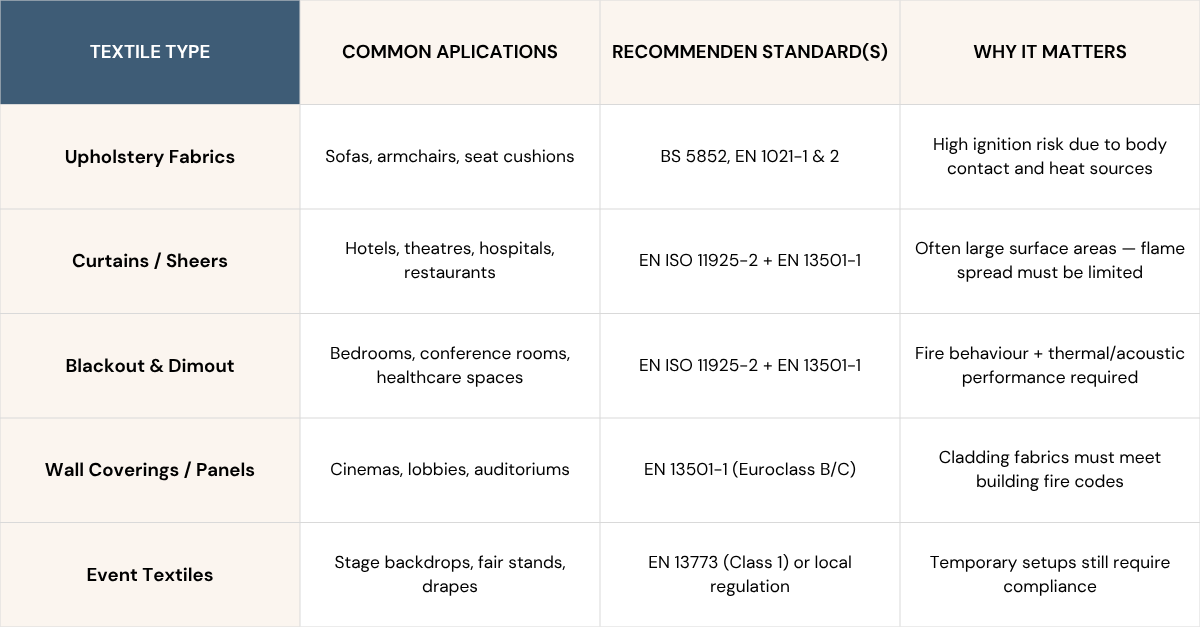
Understanding the main fire safety standards is key to compliance. Here are the most important tests and regulations used in Europe and the United Kingdom:
BS 5852: Fire tests for furniture and upholstery
The BS 5852 standard is widely applied in the UK to assess the fire resistance of upholstered furniture. It evaluates how composite materials — such as fabric and filling — respond to ignition sources like smouldering cigarettes or lit matches (the so-called cigarette test and match test).
In practice, the test involves placing a cigarette or flame source at the joint between seat and back cushions. To pass, the material must not ignite or continue to smoulder beyond a specific time.
This standard is part of the Furniture and Furnishings (Fire) (Safety) Regulations 1988, which set strict requirements for domestic furniture sold in the UK. Under this regulation, the filling materials must be fire retardant, and covers must pass the cigarette and match tests.
EN 1021: Cigarette and match ignition tests
EN 1021 is the European standard for assessing the ignitability of upholstered furniture. Like BS 5852, it is divided into two parts:
- EN 1021-1: Cigarette ignition test
- EN 1021-2: Match flame ignition test
These tests simulate the most common causes of accidental fire in domestic and public environments. For a product to be classified as fire resistant under this standard, it must not show sustained ignition or combustion.
EN 1021 is widely used across the EU and forms part of national standards, including the Spanish UNE-EN 1021. It is commonly required for textiles in contract settings such as hotels, restaurants, and auditoriums.
EN ISO 11925-2: Reaction to fire tests
The EN ISO 11925-2 standard assesses how materials behave when exposed to a direct flame source. It is used as part of the broader EN 13501-1 classification system, which evaluates building materials and products — including decorative textiles — for fire behaviour.
This test exposes a sample to a small flame for 15 seconds to observe how quickly the fire spreads and whether it produces flaming droplets or particles. It’s especially relevant for curtains and wall coverings used in public buildings, where compliance with building regulations like Spain’s CTE (Código Técnico de la Edificación) is mandatory.
Impact of fire safety regulations on textile manufacturers and suppliers
For textile manufacturers and suppliers, fire safety regulations are not just technical requirements — they shape product design, sourcing, and production.
Materials must be tested and certified according to applicable standards before being sold. This often requires investment in fire-retardant treatments, inherently fire-resistant fibres, and ongoing lab testing. Manufacturers must ensure that the combination of fabrics, foams, and construction methods all contribute to the final product’s fire performance.
Suppliers must provide documentation confirming compliance, while designers and project managers need reassurance that products are fit for purpose in regulated environments. Failing to comply can result in legal penalties, reputational damage, and even safety risks.
However, these challenges also drive innovation. The need to meet safety standards has led to new developments in sustainable fire-retardant finishes, multifunctional textiles, and performance-driven materials — all without compromising aesthetics.
Best practices for ensuring compliance of fire safety regulations for textiles
To remain compliant, textile businesses must adopt a proactive approach. Here are four key strategies:
Choosing certified materials and suppliers
Work with suppliers who provide fire certified textiles, preferably tested under EN 1021 or BS 5852. Always request technical sheets and test reports. Using certified base materials ensures a solid foundation for compliance throughout the manufacturing process.
Regular product testing and quality control
Implement a routine testing process. Every new design or production batch should undergo internal testing or third-party validation. Maintain detailed records of test results and certifications to demonstrate traceability and compliance during audits.
Risk assessment and fire safety audits
Conduct regular fire risk assessments across operations. From raw material storage to handling of chemical treatments, every step should be reviewed for safety vulnerabilities. Consider also offering guidance to clients on maintaining the fire resistance of textiles in use — for instance, after washing or exposure to sunlight.
Choosing innovative fire-retardant textiles solutions and products
Embrace innovation. Today’s textile technologies offer inherently fire-retardant fabrics that retain performance over time. Environmentally friendly coatings, halogen-free finishes, and multifunctional fabrics (acoustic, antibacterial, blackout) can all help projects meet both safety and design goals.
Why choose Dabedan’s fire safety textiles?
At Dabedan, we don’t just manufacture fire-retardant fabrics — we create textile solutions that inspire. With decades of experience in technical textiles, we blend creativity with precision, offering a wide range of certified fabrics for upholstery, curtains, sheers, and multi-purpose applications.
All our products comply with relevant standards, and we continuously test every production batch to ensure quality and consistency. We offer velvets, dimouts, blackouts, upholstery fabrics and lightweight sheers — all fire-retardant and designed with elegance and versatility in mind.
Our approach reflects our creator mindset: we empower interior designers, specifiers and architects to build imaginative, bold, and safe spaces. Whether you’re furnishing a theatre, designing a hotel lobby, or refurbishing a healthcare facility, our textiles help you express your vision without compromise.
Dabedan is your partner in building spaces that protect — and inspire.
Follow us:

Subscribe to our newsletter
Receive all communications in your email to stay up to date with our news, as well as news and advice about the sector.
Latest published articles


Do you need advice?
We collaborate with you to develop custom designs tailored to the needs of each project, creating the fabric according to aesthetic, quality, or usage requirements.
Get in touch with us, and we will advise you on our products, or request a free sample.
